



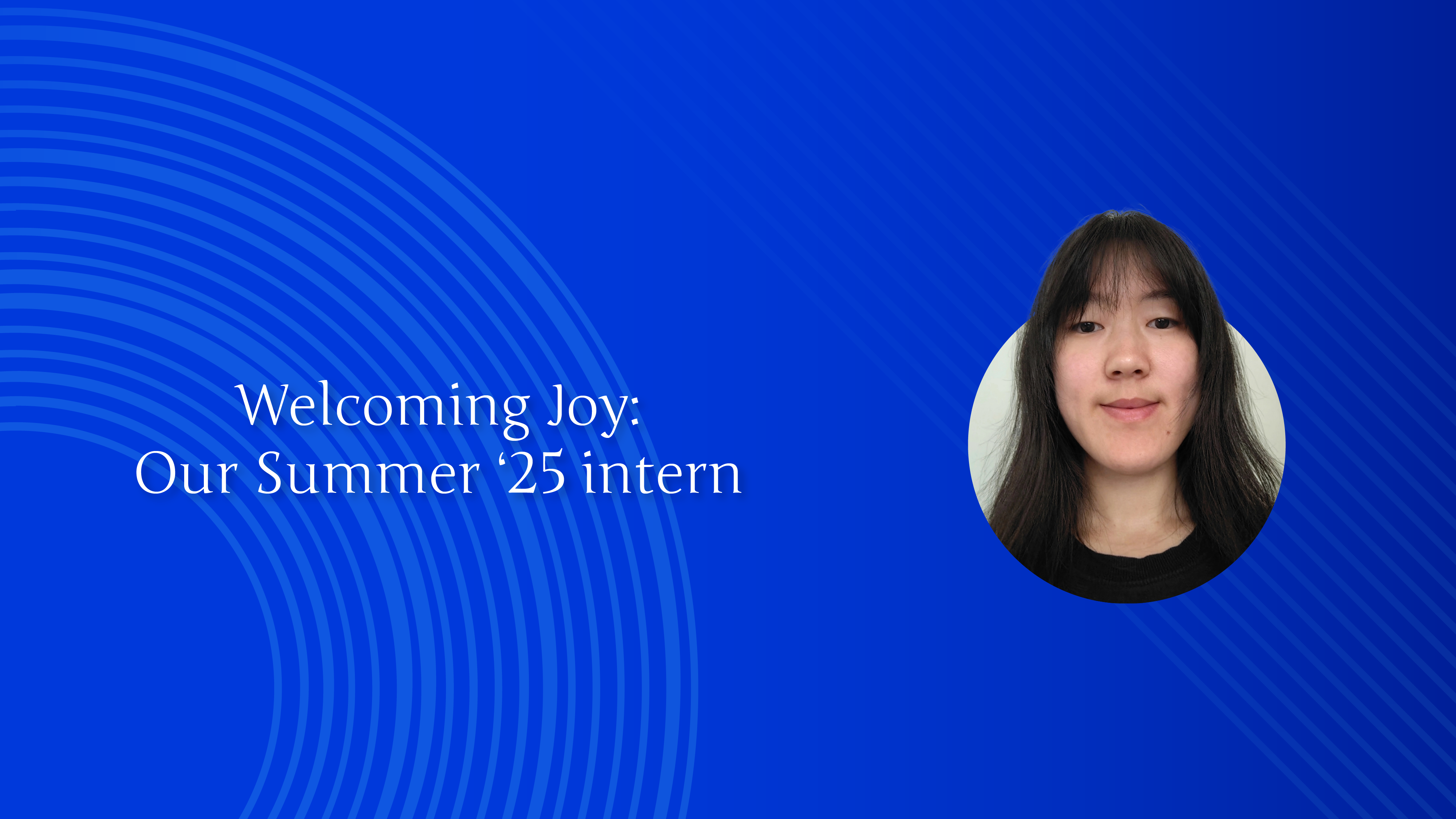
At Tokenovate, we’ve got a bit of a tradition: each summer, we invite university students to join us – either to write their master’s thesis or to take on an internship. This year is no different!
This year we’re really pleased to welcome Joy Wang to the team during July and August. We asked Joy a few questions ahead of her spending time with us, and this is what she had to say:
Hi Joy! Great to have you here. Can you tell us a bit about yourself?
Of course! I’ve just finished my first year doing an economics degree at Cambridge. So far I’ve really enjoyed the macroeconomic part of the course, particularly how a simple model can effectively capture real-world issues, such as using the Mundell-Fleming model to analyse the impact of U.S. tariff policies on exchange rates and capital flows. I like how economics can be used to intersect theory with real-life and I’m looking forward to seeing more of this in the rest of my course.
In my spare time I like to play cards with friends – I find it helps me work on my strategic thinking.
Sounds fascinating! At Tokenovate, you’ll be looking at the potential shift from traditional financial infrastructure to decentralised models. What are you hoping to discover through your research?
In TradFi, the post-trade lifecycle of a derivative involves a lengthy intermediary chain which includes central clearinghouses, collateral custodians, and regulatory reporting systems, lengthening the time and opportunity cost it takes for a trade to clear.
Strategies such as standardising data models and transaction formats – for example through the Finos Common Domain Model (CDM) as outlined by ISDA – as well as using self-executing smart contracts on a blockchain (DLT), would help to streamline the settlement process, allowing for atomic settlement. I expect to find a significant reduction in both the direct and indirect operational costs involved in replacing the current FMI with decentralised FMI.
Additionally recording all trades on a blockchain would help to ensure continuous compliance over periodic checks; this means that not only is the regulatory process faster, it is also more transparent. Such real-time oversight and immutable recordkeeping would reduce systemic risks in the current infrastructure.
Nevertheless, I anticipate there will be considerable economic challenges to integrating decentralised financial systems on a nationwide scale. I think implementing policies that reduce the costs of adopting innovative frameworks would help to accelerate the process of creating a more secure environment for the financial system.
And what about after university – any big plans?
Undertaking further education by doing a master’s would be valuable, as I aim to develop a more advanced understanding of economics. I hope to use what I have learned – and will learn – to inform meaningful policy decisions, by working for a think tank or the Bank of England. I’m interested in using economic analysis to solve challenges such as financial instability, inequality, and climate-related risks.
We’re thrilled to have Joy with us this summer, and can’t wait to see where her research takes her. Welcome aboard!